

briefin turns chaotic requests into structured, actionable briefs. Built for creative teams juggling deadlines, approvals, and last-minute changes.


.svg)


Scope creep is one of the few problems that teams across marketing, product, and creative work all recognise immediately.
Projects expand. Timelines slip. Budgets stretch. Teams renegotiate what “done” actually means halfway through delivery. Everyone involved has a version of why it happened, and those explanations usually point outward: clients changed direction, stakeholders got involved late, priorities shifted.
What’s notable is how normal this has become. Scope creep is discussed as an inconvenience rather than a structural issue: something to be managed, absorbed, or priced in.
But when the same problem shows up across different teams, industries, and levels of experience, it’s worth asking a harder question: what if scope creep isn’t a behavioural issue at all, but the predictable outcome of how work is defined before it begins?
When you look closely, most scope creep traces back to the same place: briefing. Not the quality of individual briefs, but the way briefing functions or fails to function, as a system in modern work.
Most teams still talk about briefs as if they are intentional, well-formed starting points. In practice, that’s rarely how work begins.
Briefs usually arrive late, partially, and indirectly shaped by the tools teams use and the pace they’re working at. The result is that the “brief” becomes a reconstruction of intent rather than a clear articulation of it.
Across agencies, marketing teams, and product organisations, briefs tend to arrive in a handful of predictable ways.
A common pattern is that alignment happens verbally, often across several meetings, and the brief is written afterwards as a summary. Key points are remembered, others are implied, and some are quietly dropped.
What gets lost here is decision quality. Conversations include uncertainty, disagreement, and unresolved trade-offs. The written brief rarely captures those edges. It presents a cleaner version of reality than the one people actually discussed.
Later, when those unresolved questions resurface, it feels like scope has changed. In reality, it was never settled.
Another frequent approach is reuse. Someone pulls up the last brief that “felt similar” and adapts it quickly. Sections are left in place even when they don’t fully apply. Assumptions baked into the old project carry over into the new one.
This saves time up front, but it imports decisions that were made for a different context, a different team, or a different set of constraints. Over time, teams stop noticing which parts of the brief are intentional and which are inherited.
When those inherited assumptions collide with reality, revisions follow.
Briefs are often produced once work has already started, usually because a project needs to move forward and documentation is required to unlock execution.
In these cases, the brief becomes a justification rather than a foundation. It reflects what feels safest to commit to in writing, not what actually needs to be decided. Ambiguity is left vague on purpose, with the assumption it can be handled later.
This creates a false sense of alignment. Everyone agrees to move forward, but for different reasons.
Many teams rely on Jira, Asana, (or even WhatsApp 🤯) to “capture the brief.” The structure of the tool shapes the thinking: short descriptions, fixed fields, limited space for nuance.
These tools are good at tracking tasks. They are not designed to surface intent, constraints, or trade-offs. As a result, complex decisions are compressed into summaries that look complete but aren’t.
The missing context moves into comments, DMs, and side conversations, where it’s harder to find and easier to misinterpret.
Perhaps the most common issue is cultural rather than technical. Briefs are treated as something you “have to do” rather than something that actively shapes the work.
Once approved, they are rarely revisited. When reality shifts (as it always does) the brief stays frozen. Teams adapt informally, but the source of truth never catches up.
Over time, the gap between what the brief says and how the work is done widens. Feedback then appears to introduce new scope, when it is often responding to decisions that were never properly captured.
These briefing patterns persist because they rely on assumptions that feel reasonable in the moment. Most of the time, no one realises they’re making them.
In practice, most briefs depend on four underlying assumptions.
Briefs often skip background, decision history, and rationale. The assumption is that everyone involved already understands the bigger picture.
Research suggests otherwise. McKinsey estimates that knowledge workers spend nearly 20% of their time searching for information or clarifying context, largely because critical information is fragmented across tools and conversations:
When context isn’t explicit, each person reconstructs it differently.
Many briefs state what needs to be delivered without clarifying what trade-offs are acceptable or which constraints matter most.
The Project Management Institute consistently identifies poor requirements definition as a leading contributor to project overruns and failures:
What’s written looks clear. What’s missing only becomes visible later.
Teams often move forward with unresolved ambiguity, assuming it can be handled during delivery. This works until decisions becomes expensive to change.
The Standish Group’s CHAOS reports repeatedly show that incomplete requirements remain one of the most persistent causes of challenged projects.
Social dynamics, time pressure, and hierarchy all work against this assumption. Most people don’t challenge unclear briefs unless forced to.
Instead, they infer. Those inferences compound.
Scope creep usually shows up once work is already in motion - visible, integrated, or under review. That timing matters.
By the time feedback arrives, effort has already been invested. What might have been a small clarification early on, now feels like a significant change and tension rises, even when the feedback itself is reasonable.
Adobe’s State of Create report found that creatives spend more than 40% of their time on revisions and rework, much of it driven by unclear or shifting expectations:
Ultimately, rework is the cost of unresolved decisions and not poor execution.
If this feels familiar, it usually means decisions are being made implicitly rather than deliberately. Tools don’t fix that by themselves, but better briefing systems force clarity earlier, when it’s still cheap.
Most organisations try to solve briefing problems by improving documentation. They add fields, standardise templates, or introduce new forms.
This approach assumes the issue is completeness. If everything were written down, alignment would follow.
But documents capture answers. They don’t guide judgment.
In fact, poorly structured requirements lead directly to rework and usability failures, especially in complex systems.
Until recently, teams could absorb some ambiguity. Clarification happened informally. Misalignment was corrected gradually.
AI changes that dynamic.
Large language models respond directly to input structure. Vague inputs produce fluent but misaligned outputs. Clear, constrained inputs produce materially better results.
Anthropic’s guidance on prompt design makes this explicit: reliability improves when assumptions, constraints, and context are clearly structured:
https://www.anthropic.com/news/prompting-guide
As teams start using AI for planning, ideation, and execution, briefing quality becomes the bottleneck. That’s why more teams are actively looking for structured, AI-native briefing tools rather than better templates.
What a modern briefing system needs to do
Treating briefing as a system rather than a document changes the requirements entirely.
Any modern briefing system needs to do five things well.
Harvard Business Review has repeatedly shown that decision quality depends heavily on how problems are framed at the outset.
Briefing sits upstream of execution. When it fails, everything downstream compensates.
If your current briefs can’t do all five of these consistently, the problem is the system you’re using – Try briefin ->
Most existing tools weren’t designed for this role.
Project management tools track work. Document tools store text. Prompt tools generate output. None are built to structure thinking before execution across teams and over time.
This gap is driving the emergence of AI-native briefing systems: tools designed to guide decision-making, not just record it.
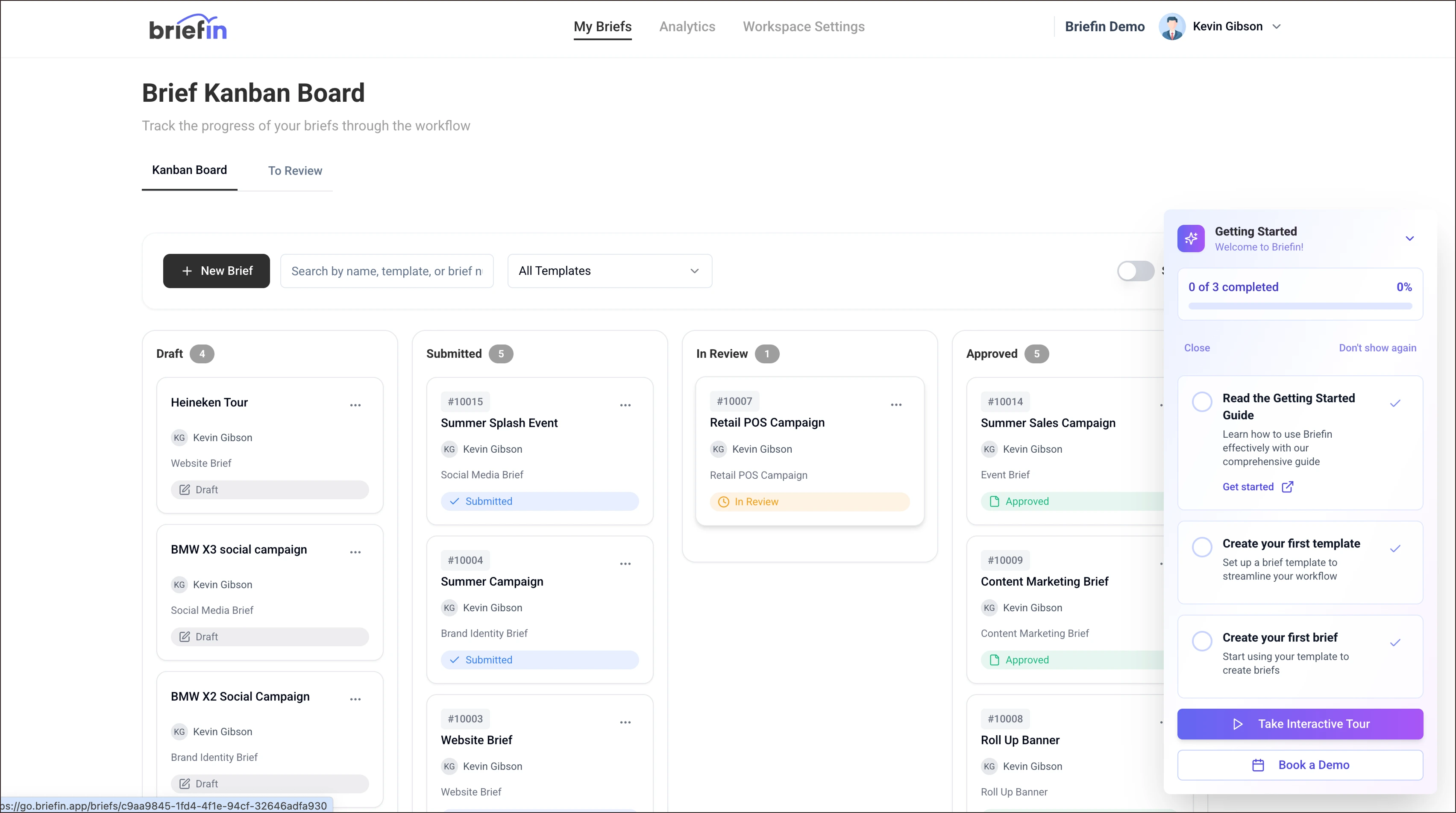
briefin is designed to support teams in creating, managing, and improving briefs as part of an ongoing workflow, rather than as one-off documents.
It provides a single place where briefs can be created, reviewed, updated, and analysed over time, with structure built into the process rather than left to individual preference.
At a functional level, briefin focuses on six core capabilities.
briefin allows teams to create reusable briefing templates using drag-and-drop fields and flexible logic.
Templates can be tailored to different types of work including campaigns, product features, creative requests, internal projects, while keeping a consistent structure across the organisation. This helps teams standardise how information is captured without forcing every brief into the same shape.
briefin includes AI assistance to help users rewrite, summarise, or clarify briefs.
This is particularly useful when requests arrive incomplete, unclear, or overly verbose. Teams can refine language, tighten scope descriptions, and make requirements easier to interpret before work begins, reducing ambiguity at handoff points.
briefin supports approval workflows that route briefs to the right reviewers and track their status from draft through to approval.
This makes it clear where a brief sits at any point in time, who has reviewed it, and what feedback has been provided. It also creates a visible checkpoint before execution begins, rather than relying on informal sign-off.
Every brief in briefin includes version history, showing changes and comments in a complete timeline.
Teams can see how a brief has evolved, understand when and why updates were made, and restore earlier versions if needed. This makes it easier to distinguish between clarified requirements and genuinely new requests as work progresses.
briefin provides an analytics dashboard that gives visibility into how briefs move through the system.
Teams can track brief volume, review times, and approval bottlenecks, helping them identify where delays or friction tend to occur. Over time, this data supports process improvements rather than relying on anecdotal feedback.
briefin offers a fully branded interface, allowing teams to apply their own logo, colours, and fonts.
This is especially relevant for agencies and client-facing teams, where briefs are shared externally and form part of the overall experience. A consistent, on-brand interface helps briefs feel intentional and professional rather than ad hoc.
briefin supports a more consistent briefing process. Decisions are captured earlier, changes are easier to track, and context is less likely to be lost as work moves from request to execution.
This doesn’t remove the need for discussion or change, but it does make the briefing layer more visible and easier to work with, which reduces the likelihood that unresolved questions surface late as scope issues.
You can explore how briefin works here.
Scope creep persists because teams are solving the wrong problem.
They focus on managing change instead of improving how decisions are made early. They invest in execution speed while neglecting input quality.
As work becomes more complex and more automated, that imbalance becomes harder to sustain.
Briefing is no longer a formality. It’s infrastructure.
Until teams treat it that way, scope creep will remain a feature of modern work rather than a failure.
If scope creep keeps showing up in your work, it’s worth looking upstream.
briefin helps teams structure decisions before execution begins, so briefs stop being a source of confusion and start acting as real alignment tools.
.svg)
Scope creep refers to work expanding beyond its original agreement over time. It often happens because key decisions, constraints, or assumptions weren’t fully clarified at the start. When those gaps surface later, changes feel like new scope rather than unresolved questions coming to light.
Scope creep is commonly attributed to clients changing direction, but it usually starts earlier. In many cases, briefs are incomplete, inconsistent, or spread across multiple tools, which leads different people to interpret the work differently. Those differences tend to surface later as revisions or additional requests.
Poor briefs leave room for interpretation. Teams fill in gaps based on assumptions, which can diverge over time. When expectations are reviewed or integrated later, misalignment becomes visible, leading to rework, delays, and additional approval cycles.
Templates and documents help standardise information, but they don’t guide decision-making. They rely on the person writing the brief to already know what needs to be clarified. In complex or fast-moving work, this often results in important context or constraints being left implicit.
AI systems rely heavily on input clarity. When briefs are vague or incomplete, AI-generated outputs can be misaligned or misleading. Structured briefing helps ensure that objectives, constraints, and context are clear, which improves the quality and reliability of AI-assisted work.
A modern briefing tool should support structured inputs, allow briefs to evolve over time, track changes and approvals, and make context easy to reuse. It should also integrate well with AI workflows, where clear, consistent inputs directly affect outcomes.
briefin turns chaotic requests into structured, actionable briefs. Built for creative teams juggling deadlines, approvals, and last-minute changes.